Why HDPE Liners Are the Best Choice for Water Storage Projects in India
India is facing a water crisis of unprecedented proportions. As the country hosts 17% of the world's population on just 2.4% of its land area, competition for freshwater resources grows fiercer every year. In this scenario, HDPE liners for water storage projects in India have emerged as one of the most effective, affordable, and sustainable solutions available to farmers, engineers, and water managers across the country. From rural farm ponds in Maharashtra to industrial reservoirs in Gujarat, HDPE (High-Density Polyethylene) geomembrane liners are transforming how India stores, conserves, and manages water.
This comprehensive guide explores the science, applications, benefits, and economics of HDPE pond liners — and explains why they consistently outperform alternatives like PVC liners and concrete reservoirs.
India's Water Challenge: Why Better Storage Solutions Are Urgently Needed
The numbers are stark. According to NITI Aayog, 21 major Indian cities are projected to run out of groundwater by 2030, and approximately 600 million Indians already face high-to-extreme water stress. India's agricultural sector — which consumes over 80% of available freshwater — loses an estimated 30–40% of irrigation water to seepage and evaporation in unlined canals and farm ponds.
Government initiatives like the Pradhan Mantri Krishi Sinchayee Yojana (PMKSY) and Mahatma Gandhi National Rural Employment Guarantee Scheme (MGNREGA) have funded thousands of farm ponds and check dams across India. However, without proper lining, the majority of these water bodies suffer significant seepage losses within their first few monsoon seasons. This is precisely where HDPE geomembrane liners deliver transformative results.
Key statistics at a glance:
- India loses an estimated 40% of irrigation water to seepage in unlined canals (Central Water Commission, 2022).
- Properly lined farm ponds reduce seepage by up to 95%, significantly improving water availability for crops.
- The global pond liners market was valued at USD 3.7 billion in 2025, with HDPE dominating at 61% market share.
- Agriculture accounts for 48% of total global pond liner demand, with India being one of the fastest-growing markets.
What Is an HDPE Geomembrane Liner?
HDPE (High-Density Polyethylene) geomembrane is an impermeable, flexible sheet manufactured from high-quality polyethylene resin. It is engineered specifically to act as a barrier against fluid migration — whether that fluid is irrigation water, fish pond water, industrial effluent, or collected rainwater. HDPE liners are produced in thicknesses ranging from 0.5 mm (500 microns) to 3.0 mm depending on the application, and are available in widths of up to 8–13.5 metres to minimise on-site welding joints.
In India, HDPE geomembrane sheets are manufactured under Bureau of Indian Standards specifications (IS 15351) and tested for properties including tensile strength, tear resistance, UV stability, and chemical resistance. Reputable HDPE liner manufacturers in India supply both standard and textured surfaces, with textured variants offering improved friction on slopes.
HDPE Lining Benefits: 10 Reasons to Choose HDPE for Water Storage
1. Near-zero water seepage
The primary function of any pond liner is leak-proof water retention. HDPE liners achieve seepage rates as low as 0.0001 cm/sec — effectively eliminating water loss through the pond bed and sides. Compared to unlined earthen ponds that can lose 30–50% of stored water through seepage, this translates to dramatically higher water availability for agriculture, aquaculture, and industry.
2. Exceptional lifespan
A properly installed HDPE geomembrane liner typically lasts 20 to 50 years under normal field conditions. Leading HDPE liner manufacturers in India provide warranties of 10–25 years, backed by material certifications. The polymer does not rot, rust, or biodegrade, making it ideal for both submerged and exposed applications.
3. Superior UV and chemical resistance
India's climate presents extreme UV radiation, particularly in Rajasthan, Gujarat, and the Deccan Plateau. HDPE liners are formulated with carbon black UV stabilisers (typically 2–3% by weight) that protect against solar degradation even when partially or fully exposed to sunlight. Simultaneously, HDPE's outstanding chemical resistance makes it suitable for lining effluent ponds, chemical storage lagoons, and leachate containment areas where PVC or clay liners would fail prematurely.
4. Cost-effective water storage solution
At approximately Rs. 50–120 per square metre (depending on thickness and order quantity), HDPE pond liners offer enormous cost advantages over concrete-lined reservoirs, which typically cost Rs. 500–1,200 per square metre. For a 1,000 sqm farm pond, HDPE lining may cost Rs. 70,000–1,20,000 versus Rs. 5,00,000–12,00,000 for concrete — savings that put professional-grade water storage within reach of individual farmers.
5. Fast and versatile installation
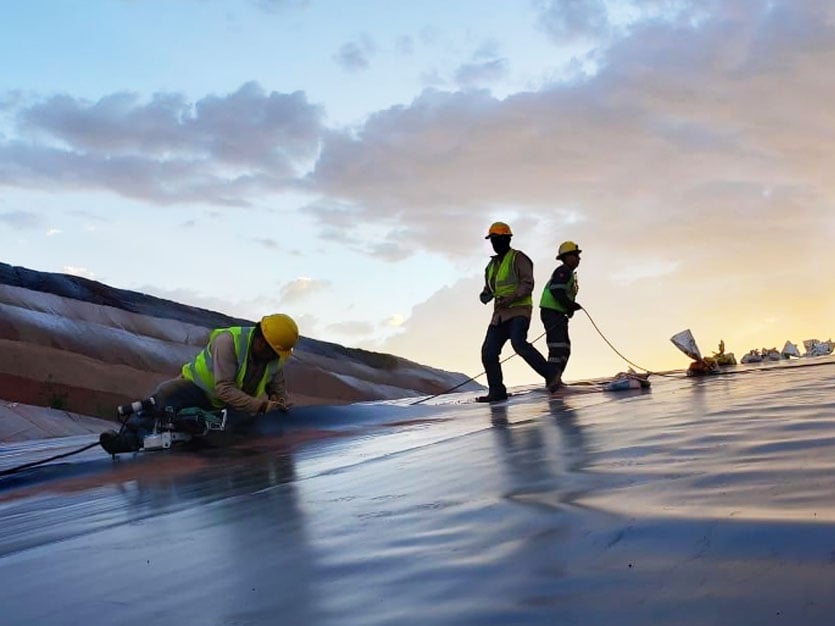
HDPE liner installation for a typical farm pond can be completed within 1–3 days using a small team. The sheets are welded on-site using hot wedge or extrusion welding machines, creating seams that are as strong as or stronger than the parent material. Unlike concrete, there is no curing time, no seasonal restriction, and no requirement for specialised civil construction equipment.
6. Flexible — conforms to any shape
Whether the water storage structure is a rectangular farm pond, an irregularly shaped check dam, a circular biogas digester, or a contoured landscape reservoir, HDPE liners conform to the substrate with precision. The flexibility of HDPE geomembrane eliminates the cracking risk associated with rigid concrete liners during seismic events or differential settlement.
7. Eco-friendly and fish-safe
HDPE is chemically inert and does not leach harmful substances into stored water. It is certified safe for contact with drinking water and aquatic life, making it the preferred liner for fish farming and prawn aquaculture operations. Additionally, HDPE is recyclable at end of life, reducing long-term environmental impact.
8. Low maintenance requirements
Unlike concrete reservoirs that develop cracks requiring annual repair, or clay-lined ponds that need periodic re-lining, HDPE pond liners require minimal ongoing maintenance. Routine inspection for punctures (typically caused by animal activity or sharp debris) and periodic cleaning of algae build-up are generally sufficient.
9. Reduces water-borne disease risk
Unlined ponds in rural India can become breeding grounds for mosquitoes and pathogens, particularly when water seeps into and saturates surrounding soil. A sealed HDPE-lined pond maintains cleaner water quality, reduces soil saturation around the structure, and contributes to better public health outcomes in agricultural communities.
10. Supports government subsidy schemes
Multiple central and state government schemes in India — including PMKSY, MGNREGA farm pond components, and the National Watershed Management Project — specifically mandate or incentivise the use of geomembrane liners for funded water structures. Farmers and project implementers using HDPE liners may be eligible for subsidies of up to 50–90% of material and installation costs under applicable schemes.
Applications of HDPE Liners Across Key Sectors in India
Agricultural water storage and irrigation
Farm pond lining is the single largest application for HDPE geomembrane in India. With millions of farm ponds constructed or planned under government schemes, HDPE liners prevent seepage losses that would otherwise render these ponds non-functional within 2–3 monsoon seasons. Lined farm ponds can store water through the dry season, enabling a second or third crop cycle — dramatically increasing farmer income. For irrigation channels and canals, HDPE canal lining reduces conveyance losses and improves water delivery efficiency across the system.
Aquaculture and fish farming
India is the second-largest fish producer in the world, with freshwater aquaculture representing a significant and growing share. HDPE pond liners are now standard practice in intensive fish and shrimp farming operations, particularly in Andhra Pradesh, West Bengal, Kerala, and Odisha. The smooth, inert HDPE surface prevents burrowing by fish, eliminates the mud bottom that harbours pathogens, and makes pond draining and cleaning far more efficient. HDPE liners rated 500–750 microns are most commonly specified for aquaculture ponds.
Industrial reservoirs and effluent treatment
Industrial facilities including textile mills, pharmaceutical manufacturers, tanneries, and chemical plants require leak-proof containment for process water, cooling water, and effluent lagoons. HDPE geomembrane liners — typically 1.0–2.0 mm thickness — provide the chemical resistance and impermeability required to meet Central Pollution Control Board (CPCB) standards. Their use prevents soil and groundwater contamination from industrial discharges, protecting surrounding communities and ecosystems.
Rainwater harvesting
With India's monsoon delivering 80% of annual rainfall within just 100–120 days, effective rainwater harvesting infrastructure is critical. HDPE liners are used in rooftop collection systems, community water harvesting tanks, percolation ponds, and recharge structures. Their impermeability ensures that collected rainwater is stored rather than lost to seepage, while their hygienic surface maintains water quality for both agricultural and potable uses.
Wastewater treatment and biogas
Municipal sewage treatment plants, industrial effluent treatment facilities, and biogas digesters in India increasingly specify HDPE geomembrane for lining treatment lagoons and digester covers. In the biogas sector, HDPE liners serve the dual purpose of waterproofing the digester pit and forming the gas-collecting membrane, supporting India's growing renewable energy sector.
HDPE Liners vs PVC Liners vs Concrete Reservoirs — Detailed Comparison
Understanding how HDPE compares to alternative lining solutions helps project planners make informed decisions. The table below summarises the key differences:
| Feature | HDPE Liner | PVC Liner | Concrete Reservoir |
|---|---|---|---|
| Lifespan | 20–50 years | 10–20 years | 30–50 years |
| UV Resistance | Excellent | Moderate | N/A |
| Chemical Resistance | Very High | Moderate | Low |
| Installation Time | Fast (days) | Fast (days) | Slow (weeks) |
| Cost (per sqm approx.) | ₹50–₹120 | ₹80–₹150 | ₹500–₹1,200 |
| Flexibility | High | Moderate | None |
| Eco-Friendly | Yes (recyclable) | Low | Moderate |
| Maintenance | Minimal | Moderate | High |
| Seepage Prevention | Near-zero | Low seepage | Moderate seepage |
| Best For | Ponds, reservoirs, canals | Garden ponds, small tanks | Large dams, bridges |
For most water storage projects in India — from small farm ponds to large agricultural reservoirs — HDPE geomembrane liners offer the optimal combination of performance, durability, and cost-effectiveness. Concrete may be preferred for very large permanent structures where long-term rigidity is required, while PVC can be a cost option for small ornamental garden ponds, but for functional agricultural and industrial water storage, HDPE is the industry standard.
HDPE Liner Installation: A Step-by-Step Overview
Professional HDPE liner installation follows a systematic process to ensure a watertight, durable result:
- Site preparation: Remove all sharp objects, roots, and debris from the pond bed and slopes. Compact and grade the subgrade to a smooth, uniform surface with no protrusions greater than 25 mm.
- Geotextile underlay (if required): For rocky or uneven subgrades, a non-woven geotextile protection layer is placed beneath the HDPE liner to prevent puncture.
- Liner panel layout: HDPE sheets are rolled out and positioned to cover the entire pond surface with appropriate overlap margins at seams (typically 100–150 mm).
- On-site welding: Adjacent panels are welded using a hot wedge welding machine (for straight seams) or extrusion welder (for repair patches and complex angles). Weld quality is tested using air pressure testing or vacuum box testing.
- Anchor trench installation: The perimeter of the liner is anchored in a trench (typically 500 mm deep, 500 mm wide) around the pond edge to prevent uplift and maintain tension.
- Backfilling and inspection: The anchor trench is backfilled and compacted. The completed installation is inspected for any damage, with repairs made using HDPE patch material and extrusion welding.
Choosing the Right HDPE Liner Thickness for Your Project
Selecting the correct geomembrane thickness is essential for both performance and cost optimisation:
- 300 microns (0.3 mm): Suitable for temporary water storage, lightly trafficked surfaces, and garden ponds.
- 500 microns (0.5 mm): The most widely used thickness for farm ponds, check dams, and agricultural reservoirs in India.
- 750 microns (0.75 mm): Recommended for commercial fish farming, larger irrigation reservoirs, and moderate chemical exposure.
- 1,000–2,000 microns (1.0–2.0 mm): Specified for industrial effluent containment, landfill lining, mining applications, and high-traffic surfaces.
Frequently Asked Questions (FAQs)
Q: What is the lifespan of an HDPE pond liner in Indian conditions?
A high-quality HDPE geomembrane liner typically lasts 20–50 years in Indian field conditions, depending on installation quality, UV exposure, chemical contact, and thickness. Liners used in permanently submerged pond applications tend to last longer than those with regular sun exposure. Most reputable HDPE liner manufacturers in India offer product warranties of 10–25 years.
Q: What thickness of HDPE liner is best for a farm pond in India?
For agricultural farm ponds in India, 500 microns (0.5 mm) HDPE geomembrane is the most widely recommended thickness. It provides an excellent balance of durability, puncture resistance, and affordability. For ponds subject to vehicle traffic on the slopes or commercial aquaculture operations, 750 microns is often preferred.
Q: Can I get a government subsidy for HDPE pond lining?
Yes. Multiple central and state government schemes provide financial assistance for pond lining in India. Under MGNREGA's farm pond component, HDPE lining costs are included in the approved expenditure. The Pradhan Mantri Krishi Sinchayee Yojana (PMKSY) also supports farm pond construction with lining. Subsidy percentages vary by state — small and marginal farmers may receive up to 90% subsidy in some states. Contact your local Krishi Vigyan Kendra or Agriculture Department for state-specific scheme details.
Q: How is HDPE liner different from PVC liner?
HDPE liners generally outperform PVC in several critical areas: they have significantly better UV resistance, longer service life (20–50 years vs 10–20 years for PVC), superior chemical resistance, and are more environmentally friendly as they are recyclable and contain no plasticisers. PVC liners may be more flexible in cold temperatures, but in India's warm climate, HDPE is almost universally preferred for functional water storage applications.
Q: Is HDPE pond liner safe for fish farming?
Yes, HDPE geomembrane is completely safe for aquaculture applications including fish and shrimp farming. It is chemically inert, does not leach toxins into the water, and is certified safe for contact with aquatic life. The smooth surface of the liner also prevents fish from burrowing or damaging the pond structure, and makes pond cleaning and disinfection significantly easier.
Q: What is the approximate cost of HDPE pond lining in India?
HDPE pond liner prices in India typically range from Rs. 50 to Rs. 120 per square metre for material alone, depending on thickness, brand, and order quantity. For a typical 1,000 sqm farm pond (including material and installation), total HDPE lining costs generally range from Rs. 80,000 to Rs. 1,50,000. This is significantly lower than concrete lining (Rs. 5–12 lakh for the same pond) and offers better long-term value. Contact HDPE liner suppliers for project-specific quotations.
Q: How long does HDPE liner installation take?
For a standard farm pond of 500–2,000 sqm, a professional installation team can typically complete HDPE liner installation in 1–3 days. Larger industrial reservoirs or complex terrain may require 1–2 weeks. The fast installation timeline compared to concrete (which requires weeks of construction plus curing time) is one of HDPE's key practical advantages.